Those tiny curled-up portraits can hold an entire season of your life in one frame: the soft hair, the impossibly small fingers, the way your baby fits against your chest. But when you are newly postpartum and responsible for someone so precious, it is natural to ask, are newborn photos safe? They can be, when your baby’s comfort and well-being guide every decision in the room.
A newborn session should never be about chasing a pose or recreating an image at all costs. It should be a calm, baby-led experience where safety comes first, your family is supported, and the photographs reflect the beginning of your story exactly as it is.
Are Newborn Photos Safe When Posing Is Involved?
Newborn photography is safe when it is handled by a photographer who understands that babies are not props. A safe photographer watches your baby closely, moves slowly, works within their natural range of motion, and is comfortable changing the plan when your little one needs something different.
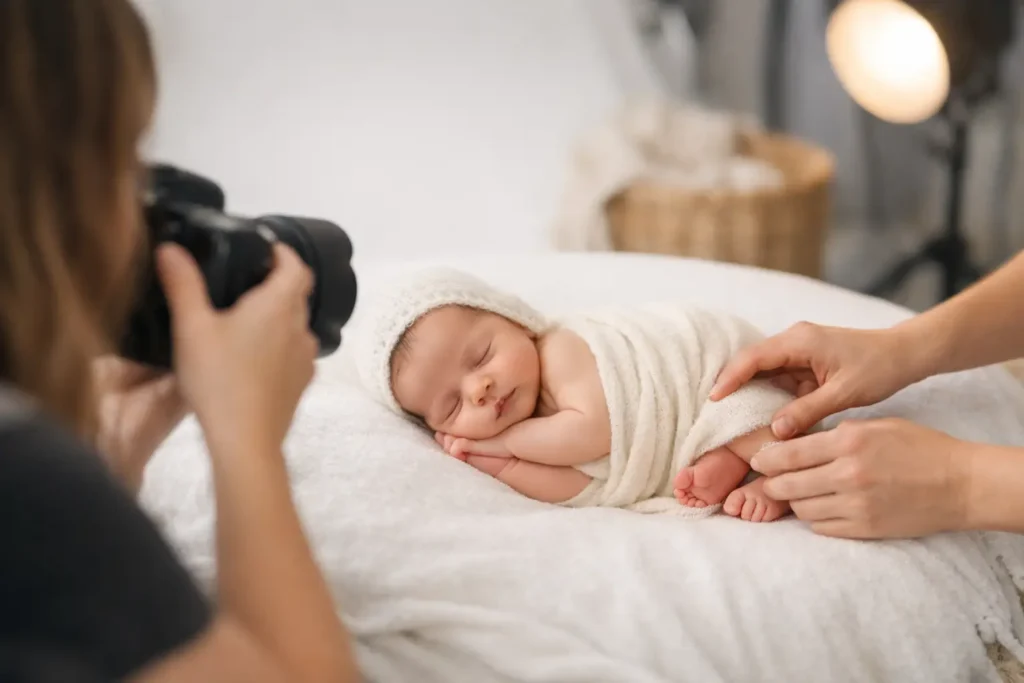
Many of the sleepy, tucked-in portraits parents love are created with careful support and thoughtful positioning. Your baby should never be forced into a position, have limbs pulled into place, or be left unsupported on a prop. Some more elaborate-looking images are made as composites, meaning the photographer takes separate photos while an adult keeps a steady hand on the baby, then combines the images during editing. The support is present in the real moment, even if it does not appear in the final photograph.
A baby who is awake, stretching, feeding, or asking to be held is not “being difficult.” They are communicating. The most meaningful session often follows that communication instead of working against it. A wrapped portrait, a parent’s hands around tiny feet, or a quiet image of your baby resting on your chest can be just as timeless as a posed image.
A Spotter Is Part of Safe Newborn Photography
A newborn should never be balanced, elevated, or placed in a container without close adult support. For certain setups, a parent or assistant needs to remain within arm’s reach, often with a hand on the baby the entire time.
This matters especially with bowls, baskets, chairs, hanging fabrics, and sibling portraits. A polished final image may look simple, but the setup should involve careful preparation, stable surfaces, soft padding, and constant supervision. If a photographer dismisses your questions about support or asks you to step away while your baby is on a prop, that is a reason to pause.
What a Safety-First Session Feels Like
Parents often imagine newborn photography as a long stretch of trying to keep a baby asleep. In reality, a well-guided session makes room for the unpredictable rhythm of early parenthood. Feeding breaks, diaper changes, cuddles, and soothing are all part of the experience.
The studio space should feel comfortable and clean, with warm layers available for baby and enough time that no one feels rushed. Because newborns have difficulty regulating their body temperature, warmth should be monitored thoughtfully. A photographer may use a space heater to create a cozy environment, but it should be positioned safely away from your baby and never aimed too closely at them.
Hands should be washed before handling baby, fabrics and wraps should be freshly laundered, and props should be cleaned between sessions. If anyone in the household or studio team is sick, the session should be rescheduled. These are quiet details, but they are part of the care that lets you settle in and enjoy the moment.
At Willow & Roots Studios, the goal is not to make your baby fit a rigid vision. It is to guide your family through a gentle experience that honors this fleeting chapter while protecting the comfort of the smallest person in the room.
Your Baby Sets the Pace
Every newborn arrives with a different temperament, feeding schedule, and level of sensitivity to sound, touch, and movement. Some settle beautifully when wrapped. Some prefer to stay awake and watch the room. Some only want to sleep in a parent’s arms. All of those responses are normal, and all can create beautiful photographs.
A safety-minded photographer reads those cues. They notice changes in skin color, breathing, temperature, and fussiness. They stop if a baby seems uncomfortable. They never expect a baby to remain in one position beyond what feels natural.
Parents are an essential part of that process. You know your baby best, even in those first tender days. Speak up if something concerns you, if your baby has a medical consideration, or if you simply need a break. Your photographer should welcome that conversation without making you feel overly cautious.
When to Reschedule or Simplify the Plan
There are times when the safest choice is a quieter, simpler session or a new date. If your baby is unwell, has a fever, is struggling with feeding, or has been advised by their pediatrician to limit outings, their health comes before the calendar.
The same is true for parents. Recovery after birth can be physically and emotionally demanding. If you are not ready to leave home, stand for portraits, or host a session, it is okay to adjust. Family photographs do not require perfection. A seated portrait in soft window light, with your baby held close, often tells a more honest and powerful story than an elaborate plan ever could.
Questions Worth Asking Before You Book
You do not need to become a newborn photography expert to choose the right person for your family. A few clear questions can reveal whether a photographer treats safety as a core part of their process.
Ask how they support babies in props and whether they use composite editing for poses that cannot be safely held on their own. Ask about cleaning practices, illness policies, session pacing, and what happens if your baby is awake or needs frequent breaks. You can also ask to see examples of parent-supported images and sibling setups.
Pay attention to the way the photographer answers. You are looking for calm confidence, not defensiveness or pressure. A professional should be able to explain their approach clearly and should make room for your preferences. If a particular pose does not feel right to you, you never need to agree to it.
Preparing for a Comfortable Newborn Session
The best preparation is often less about getting the “perfect” sleepy baby and more about giving yourself permission to arrive as you are. Try to keep the day flexible. Feed your baby when they are hungry, bring extra diapers and a pacifier if you use one, and dress in something that makes you feel comfortable and connected to your family.
Let your photographer know about any sensitivities, birth considerations, reflux, circumcision healing, or concerns you have noticed. This information is not an inconvenience. It helps shape a session around what your baby needs.
For siblings, it can help to plan their photos early, then let them take a break with another trusted adult. Young children do best when expectations are gentle and brief. A loving hand on the baby’s back, a kiss on the forehead, or a child peeking in beside a parent can create a meaningful sibling portrait without asking too much of anyone.
The Safest Images Are Often the Most Personal
There is no single definition of a successful newborn gallery. Perhaps your baby sleeps through a wrapped portrait. Perhaps they stay wide awake, staring into the camera with the serious expression you will someday recognize in every family story. Perhaps the photograph you treasure most is the one where they settled only after you held them against your heart.
Those are not backup moments. They are your first days together, preserved with care. Choose a photographer who will protect them that way, and let the session make room for your baby to be exactly who they are.